As most advisors and sales team members already appreciate, knowing how to build a sales cadence is important. Why? That part’s simple. When you take a moment to consider the importance of sales cadences in the sales process, the benefits stack up quickly: They provide structure. They ensure consistency. They enhance quality control. They respond to — even anticipate — customer needs. They’re replicable and repeatable. They deliver predictable metrics.
And, when they’re well-designed, thoughtfully refined over time, and leveraged by capable sellers, they also boost revenue growth.
To tap those benefits, knowing how to create a sales cadence is critical — and that’s where the hard work begins. Best practices for sales cadence development call for smart, careful pre-work to know:
- Who you’re targeting,
- Where you’ll reach them,
- When — and how frequently — will you follow up,
- What each communication will say, and
- How you’ll track the success of your efforts.
In this blog, we’ll do a deep dive into sales cadence best practices, providing a sort of “how-to” kit for sellers interested in discovering and leveraging cadences as the powerful tools they are. We’ll share:
- Details on what a sales cadence is
- Steps to build an effective sales cadence strategy
- Essential tips for creating a high-quality sales cadence
- Sales cadence case studies and examples
What is a sales cadence?
A sales cadence is a series of multi-channel sales touchpoints delivered to sales prospects (e.g.: phone, email, social media) in sequence, on a predetermined timeline. Each cadence is designed to reach a specific audience of prospects and accomplish a specific sales objective.
If this sales cadence definition sounds simple, you’re reading it right. Sales cadence best practices are fundamentally straightforward. By reaching out to prospects repeatedly with timely, relevant, personalized information that demonstrates your understanding of their needs — and your ability to address them — well-designed cadences are terrific for priming the relationship and sales pipeline.
So, to warm up, let’s make things personal. Think back to a time when you went on a date — and hit it off. While we don’t know the details, we can speculate that you followed that date up with a series of communications. You probably texted. Maybe called and emailed. Maybe, just maybe, you even sent some snail-mail correspondences. Each connection was likely intended to catch your love prospect’s attention, speak to their wants and desires, and express your desire and ability to address them.
When you did that, you were essentially building a sales cadence for one (hopefully the one).
Let’s imagine how that cadence would look if you brought the same level of rapport to create a sales cadence. First, let’s take a closer look at the essential components of a sales cadence.
Sales cadence components
1. Buyer Persona
To create an effective sales cadence, you need to understand whom you’re creating it for — and that will require assumptions and research to find out who, specifically, you’ll target. From job titles to demographics to pain points, the more you know about your target, the greater your success in designing a cadence that connects — and delivers results.
2. Media Choice
Now that you know who your cadence will target, you must determine where you’ll reach them. Effective cadences typically target multiple media (e.g.: email, text, phone, social media) to improve the odds of reaching prospects where they prefer to engage.
3. Attempts
Each touchpoint in your cadence represents an attempt — and determining the right number is as much art as science: too few, and you may not connect. Too many, and you may annoy. Apply the Goldilocks rule when designing your cadences and aim for just right.
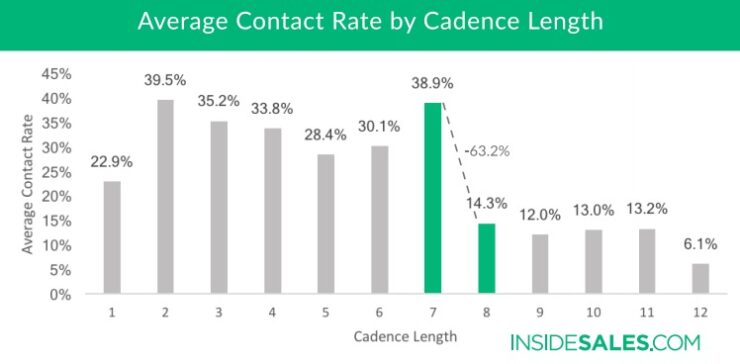
While no hard-and-fast rules exist, cadences ranging from 8-12 attempts are often considered ideal.
4. Cadence Duration
Your cadence begins with your first touchpoint and ends with the last. The duration, of course, is up to you — but a good rule of thumb is to make them long enough to catch your prospects’ attention and hold it, but not so long that attention wanes.
If executed effectively, you’ll have cues during your cadence to gauge engagement. If your prospects interact by opening emails and clicking links, that’s a sign they’re interested. But if a couple of weeks pass with no measurable reaction, it’s a good sign to disengage and focus on more responsive prospects.
5. Touchpoint Spacing
If you reach out too often, your efforts may seem desperate, even invasive. Too infrequently, and you’ll lose their attention. It’s a good practice to space touchpoints two days apart, or three at the most.
6. Content Design
What your touchpoints say — and how you say it — is vitally important. By creating a cadence with touchpoint content that is engaging, relevant, timely, and carefully targeted, you’ll significantly improve the odds of capturing and sustaining prospect interest.
Make sure each missive makes a limited number of impactful points, is well-written, and is designed to drive toward a clear, simple call to action — and your prospects will be more likely to engage and respond.
Types of a sales cadence
You can develop an outbound or an inbound sales cadence — both of which can also be considered follow-up cadences. While there are many variations on these fundamentals (like a sales engagement cadence, a b2b sales cadence, and a sales email cadence, to name a few), they all fall within these primary categories.
So, now that you’ve committed to crafting a sales cadence, it’s essential to decide which type of sales cadence best suits your needs. To summarize, that list includes:
- Outbound cadences
- Inbound cadences
- Follow-up cadences
Let’s take a closer look at each.
Outbound cadences
Essentially a supercharged, cadence-ized evolution of the traditional cold call, an outbound sales cadence begins with a personalized introductory touchpoint and plays out over multiple personalized communications designed to demonstrate awareness of the prospect’s needs and build trust in your enterprise’s ability to address them.
Inbound cadences
“77% of customers expect to interact with someone immediately when they contact a company.”
State of the Connected Customer, Salesforce, 2023
When prospects first contact you (or your enterprise), they’re potential candidates for an inbound sales cadence. Either during that initial engagement (whether via phone, email, text, social media, or otherwise) or during a follow-up, you’ll want to ask a series of qualifying questions. Then, if their needs are a potential match for your solutions, you can continue the sales process with an inbound cadence.
Utilizing a combination of both one-on-one and automated touchpoints, these cadences allow you to cultivate the customer relationship and streamline the path to purchase.
Follow-up cadences
This is simply an umbrella term for the series of pre-planned touchpoints that make up both outbound and inbound cadences.
In both cases, the follow-up cadences are designed to provide sellers with a series of standardized steps — and, ideally, customizable communications — to maintain a process that’s consistent, measurable, and, above all else, effective at turning prospects into customers.
The role of personalization
“80% of customers say customer experiences should be better considering all the data companies collect.”
State of the Connected Customer, Salesforce, 2023
Another best practice for sales cadence creation is personalization. Through the wonders of technology, the potential for greater personalization continues to grow. Every touchpoint element can be personalized, from subject lines to salutations to body content.
And thanks to the power of AI, those customizations aren’t limited to prospect names. Depending on how prospects engage, it’s possible to create algorithms that tailor cadence content to address specific pain points, opportunities, or trends.
With that level of sophistication, sellers like you can deliver communications that mimic one-on-one conversation quality with many prospects at once.
Here are some benefits of personalization from Statista:

How to build an effective sales cadence strategy
Now it’s time to get to work — the part where we dig deep to appreciate and understand the fundamentals of effective sales cadence strategy development. This is where theory turns to practice, and smart sellers embrace the difference between old-school, hit-or-miss sales efforts — and deliberate, disciplined, targeted, and repeatable sales cadence-powered relationship building.
Here, in eight steps or less, is how to build a sales cadence that will help you reach your goals.
Step 1. Define your target audience and buyer personas
As any experienced advisor or seller can attest, knowing your audience is essential to any successful sales initiative. And because sales cadences should be regarded as carefully calibrated tools to intrigue and engage targeted prospects, your first (and most foundational) task is to define an ideal customer profile (ICP) for each cadence.
To do that, you’ll need to establish your:
- Target audience — what is the industry and companies where you’ll most likely find prospects who need what you’re selling?
- Buyer personas — what do your ideal customers look like? What are their job titles and their pain points? Your current customer data should help inform this, providing demographic data on your most successful customer relationships — and information on their motivations.
Step 2. Research and understand your prospects’ buying journey
Consciously or unconsciously, your prospects go through a process to arrive at a purchasing decision. That process — that buying journey — will begin with an awareness of their need, continue with consideration of possible solutions, and resolve when they make their decision to buy.
The more you know about the triggers, duration, and considerations driving your cadence’s ICPs, the better your ability to hone your efforts to capture and sustain their attention.
Step 3. Know and refine your offering
By completing the heavy lifting in steps 1 and 2, you’ll be better positioned to refine your offering — and to make it relevant, timely, and compelling to your ICP. Give your prospect everything they need to envision your solution alleviating their burden — and making them the hero.
Step 4. Set measurable objectives and goals for your sales cadence
Key considerations here?
- Open rates.
- Response rates.
- Close rates.
- Revenue objectives.
While you may not nail them all, setting objectives allows you a baseline to refine future efforts — and make your cadence efforts more effective over time.
Step 5. Map your sales cadence timeline and establish your touchpoints
Cadences have a beginning and an end. A good rule of thumb is two to four weeks, but there are no hard-and-fast rules. Once you’ve determined the duration of your cadence, you’ll need to establish how many touchpoints your cadence will include, and what, specifically, each touchpoint will be.
Sales cadences typically include anywhere from five to 15 touchpoints — but can vary depending on objectives. Map this out in detail, and designate the channel (call, email, LinkedIn engagement, text, etc) for each.
Choose the right communication channels. Ideally, your ICP development efforts will provide insights into how your prospects consume information. Working with this knowledge, you’ll want to utilize a variety of channels to improve your odds of engaging their interest.
Step 6. Craft compelling messaging for each touchpoint
While awareness messaging is likely to dominate the front end of your cadence, each touchpoint should allow prospects to deepen their knowledge of who you are and how you can address their needs. Personalize your messaging, and, if possible, build responsiveness into your cadences so you’ll be well positioned to deepen the prospect relationship with specifically targeted communications when they respond.
Step 7. Incorporate automation and technology in your sales cadence
Automated cadences amplify seller productivity, simultaneously providing 1:1 level engagement with many prospects. While telephone touchpoints require a 1:1 connection, either live or via voicemail, other touchpoints in your cadence can be automated to continue the engagement behind the scenes — freeing your time to build more relationships. This allows prospects to consume your messaging and engage on their own terms.
AI-enhanced technologies further amplify seller efforts through large language model content creation and the use of templates to craft targeted touchpoints. These capabilities significantly reduce the time required to create and sustain cadences, allowing sellers to connect effectively with multiple prospects simultaneously.
Sales cadence best practices and tips
While technology, metrics, and customer data play a critical role in the development and execution of an effective sales cadence, the value of experience, wisdom, and human sensitivity are every bit as important. Like any endeavor, you’ll gain new insights with each new cadence you create and execute.
So when you’re in doubt, and there’s no hard-and-fast right answer, trust your instincts and consider these sales cadence best practices to make each cadence effective, engaging, and uniquely yours.
Personalize and customize cadences for each prospect
Through merging technologies and automation, some levels of personalization are simple and straightforward. Incorporating prospect names in email salutations, providing personalized response contacts, and utilizing prospect specifics in subject lines add a personal touch — without requiring sellers to tailor each of those elements personally.
Other elements of other touchpoints, however, allow advisors and sellers to increase personalization over a cadence. Through basic analytics, it’s possible to know which prospects are engaging and how — allowing sellers to manually personalize touchpoints to build the relationship either through the cadence or offline.
Be consistent and persistent — without being pushy
Because buyers receive such high volumes of marketing communications through all channels, they’re conditioned to tune a large fraction out without a second thought. In developing your cadence, walking a persistent line without being perturbing is important. This requires careful craftsmanship of communications to ensure consistent, recurring messaging that’s delivered on a reasonable timeline.
If your cadence sends six emails daily with urgent subject lines in all caps, it will fail.
But if you balance your channel mix, politely and confidently personalize relevant touchpoints, and connect on a carefully spaced timeline, you’ll improve your odds of being perceived as serious, professional, and worthy of your prospects’ time.
Strike a balance between automation and human touch (calls + emails + social)
This is a balancing act — and one that requires a great deal of intuition and good judgment to manage. Nearly every touchpoint in a cadence could be personalized and manually executed.
That approach, however, defeats many of the advantages of running a cadence in the first place. So, when you design your cadence, identify touchpoints that are intentionally hands-on:
- Phone calls;
- Personal thank-you emails;
- Comments on prospects’ LinkedIn posts.
As you contemplate personalized touchpoints, it’s entirely reasonable to intersperse them with automated messaging that’s relevant, informative, and even responsive.
This allows prospects to learn between more personalized touchpoints and to continue their buyer journey better informed and with more confidence that your solution may be a match.
A/B test and experiment with different approaches
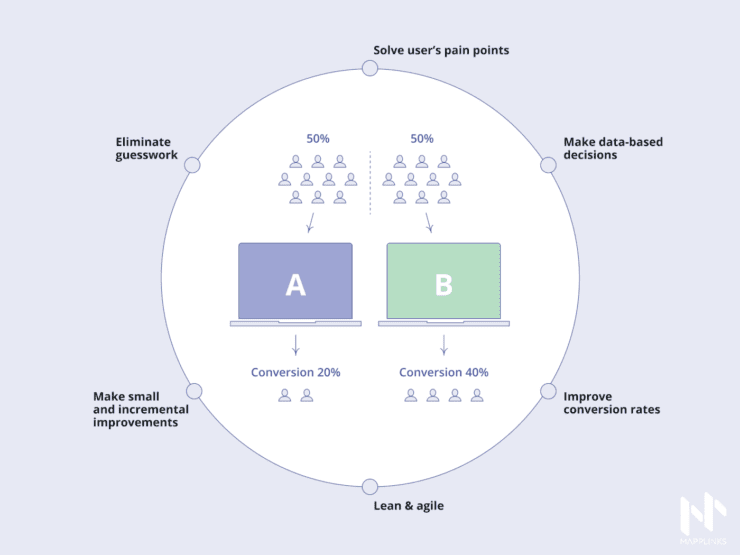
Given their duration and their use of multiple touchpoints, sales cadences offer sellers a unique opportunity to try and evaluate multiple ideas within the same campaign. With any list of prospects, it’s possible to A/B test at every step of a cadence — altering simple elements like subject lines or more significant elements, like substituting a call at a particular touchpoint for one prospect with a text or email for another.
Using analytics technologies allows you to gauge response rates to determine which approach yielded greater success and adjust future cadences accordingly.
Engage your creative side, and (within reason) the sky’s the limit.
Incorporate feedback from both sales teams and prospects
Your first sales cadence isn’t likely to be your last, and what you learn this time can significantly improve what you do next. That’s why it’s so important to seek feedback.
Your efforts will affect both the sellers who employ your cadences and the prospects who receive them — so reach out. Ask questions. Find out what worked on both sides of the cadence and embrace constructive criticism for what didn’t.
Your willingness to follow up and learn will pay enormous dividends, giving you plenty of opportunity to make your next cadence better than the last.
Sales cadence examples
If you query the search engine of your choice, you won’t have any trouble finding loads and loads of sales cadence examples to review, ponder, and judge. If you’re looking at sales cadence case studies with real-world players, you’ll be much harder-pressed to find the goods. Think about it: if you create a fantastic sales cadence for your company and it goes gangbusters, the last thing you want to do is share it with your competitor.
But take solace. A sales outreach cadence that works well for one enterprise may not perform for another. Cadences are by nature complex, each comprising a long list of variables (see ICP, touchpoints, duration, content, offer, and objectives above) that play a role in its ultimate success.
Accordingly, the cadences that follow should be considered more like guidelines than rules. Because you (hopefully) know your business and your customers well, we encourage you to customize to your heart’s content. If you feel a phone call would be more effective at a certain touchpoint than an email or an extra day between touchpoints would be a better choice, change it up.
Example I: Inbound Sales Cadence
28 Days, 13 Touchpoints
An inbound sales cadence is designed to engage prospects who’ve contacted you. Their entry point can vary: a web inquiry, a click on an email CTA, or even a quid-pro-quo registration in exchange for something of value (e.g.: white paper download, sweepstakes entry, survey). By the nature of their initial contact, they’re at least somewhat interested in what you do, so they should be receptive to one or more of the following touchpoints:
- Day 1
- Touchpoint 1: Email This is generated in response to a prospect’s query or form fill.
- Day 2:
- Touchpoint 2: Follow-up qualifying call. Reference the prospect’s query and the advisor’s/seller’s initial email. If unsuccessful in contacting, leave a detailed message and callback contact information.
- Day 4
- Touchpoint 3: Personalized social media contact. This typically includes a LinkedIn invitation or an InMail introduction referencing the prospect’s inquiry.
- Day 5
- Touchpoint 4: Email follow-up to initial email. Ideally, in the same thread. Schedule this to arrive early to pave the way for…
- Touchpoint 5: Second follow-up call. If you land in voicemail, keep it concise — or, perhaps preferably, don’t leave a message. It’s important not to overwhelm your prospect.
- Day 7
- Touchpoint 6: Email. Rather than continuing the old thread, start a new one — and update the subject line to create a fresh impression.
- Touchpoint 7: Follow-up call. Leave a voicemail this time and let them know you will email some information they can review on their own time and at their own pace.
- Day 9
- Touchpoint 8: Nurture email with call/contact-back CTA
- Day 13
- Touchpoint 9: Nurture email with call/contact-back CTA
- Day 16
- Touchpoint 10: Nurture email with call/contact-back CTA
- Day 18
- Touchpoint 11: Follow-up call
- Day 21
- Touchpoint 12: Follow-up call (and, if appropriate, voicemail with an invitation for callback)
By day 21 of your inbound sales cadence, your once-hot prospect is likely starting to feel cool. But unlike their outbound counterparts, inbound prospects are self-qualified: they expressed interest. So, unless they’ve expressly told you to back off and leave them alone, it’s fair to add periodic “maintenance” touchpoints that extend well beyond the 21-day duration of your formal cadence.
Once the cadence is complete, an email or LinkedIn InMail nudge is perfectly reasonable — and will go a long way toward keeping you and your solution in mind if the prospect’s need should become more imminent.
Example II: Outbound Sales Cadence
15 Days, 7 Touchpoints
As seasoned advisors and sales teams know, “outbound” is little more than a euphemism for “cold call.” These days, those leads benefit from some level of curation to qualify prospects, thereby increasing the odds that your touchpoints will, on some level, reach targets somewhat likely to benefit from your offer.
Like our example of an inbound sales cadence (above), this sales outreach cadence is a serving suggestion that should be considered a starting point for your own creative and strategic flourishes:
- Day 1
- Touchpoint 1: Email Intro. Remember, you’re coming from out of nowhere — so make this short, sweet, and compelling, with a clear ask for a follow-up qualifying call.
- Day 3
- Touchpoint 2: Follow–up call. Ideally, you make contact. If not, leave a brief, concise message and provide call-back info for a return call.
- Day 5
- Touchpoint 3: Email follow-up. Be sure to add some new, engaging information in case they’ve seen/heard your earlier touchpoints but haven’t felt compelled to respond.
- Day 9
- Touchpoint 4: Follow-up call. If you make contact, request a time slot for a qualifying call and/or demo at their convenience. If you reach voicemail, remind them to check their email for a link to sign up for a meeting.
- Touchpoint 5: Follow-up Email with meeting schedule request
- Day 11
- Touchpoint 6: Follow-up call and meeting request reminder
- Day 15
- Touchpoint 7: Last ask. Otherwise known as the “breakup email,” this asks the prospect whether they have any interest at this time or if they’d prefer to engage at a later date.
In most cases, a 15-day cadence walks the line between not enough contact — and too much. If you’ve reached that point without a peep in return, it’s reasonable to qualify the lead out.
You could also elect to automate a follow-up or two, spaced perhaps 30 and 90 days out from the initial touchpoint. Since you’ve invested the time and energy to complete the 15-day cadence, this is a low-cost way to make a final play for any glimmer of this stubborn prospect’s latent interest in your offer.
How to create a sales cadence with Riva
To simplify the process of creating and tracking cadences, Riva developed Cadences, as a part of the Sales Engagement module. The solution provides a range of tools designed to take the guesswork out of multi-channel cadence development — with a series of simple, step-by-step interfaces that guide the process of creating and automating cadence email and task creation and delivery.
Riva Cadences also automates tracking and analytics, allowing advisors and sellers to quickly review cadence performance. Working with a clear understanding of each touchpoint’s performance, advisors and sellers can then carry those findings forward to improve the performance of future cadences.
Let’s look at some of the tool’s essential capabilities, and how you can create a sales cadence with Riva step by step.
Step 1: Start a New Cadence/Create Cadence Flow
When choosing the “Start a New Cadence” option in Riva Cadences, users arrive at the screen captured below. They can create a cadence flow on this page by selecting the type of step they’d like to add (automated email, phone call task, or other tasks), and the condition they’d like to track (e.g.: “Email has been opened”).
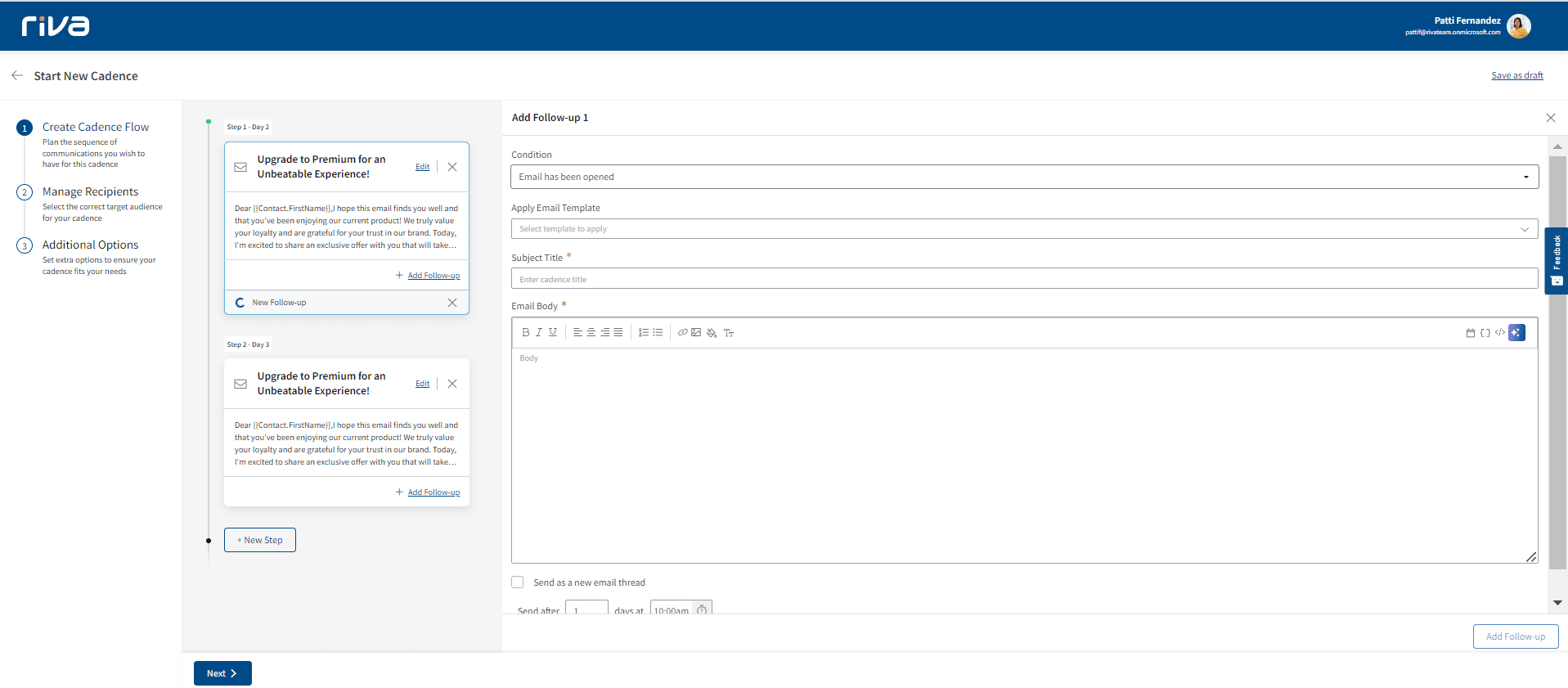
When choosing an automated email step, they can choose whether to use an existing email template, create a subject title, and enter the email’s body content.
For task steps, they can set a priority level, define a title, provide a description, add a due date, and set a flow for recipients depending on completion.
Step 2: Choose or Create an Email Template
At this step, sellers who choose to utilize an existing template can select from a range of available options. If the user elects to create a new email template, the interface provides that option and takes the user to a simple form-fill tool to simplify the email template creation process.

Step 3: Start a New Cadence/Manage Recipients
After defining the cadence flow, it’s time to enter email recipient details. Users can choose to manually enter email contact information, import by CSV, or from Salesforce.

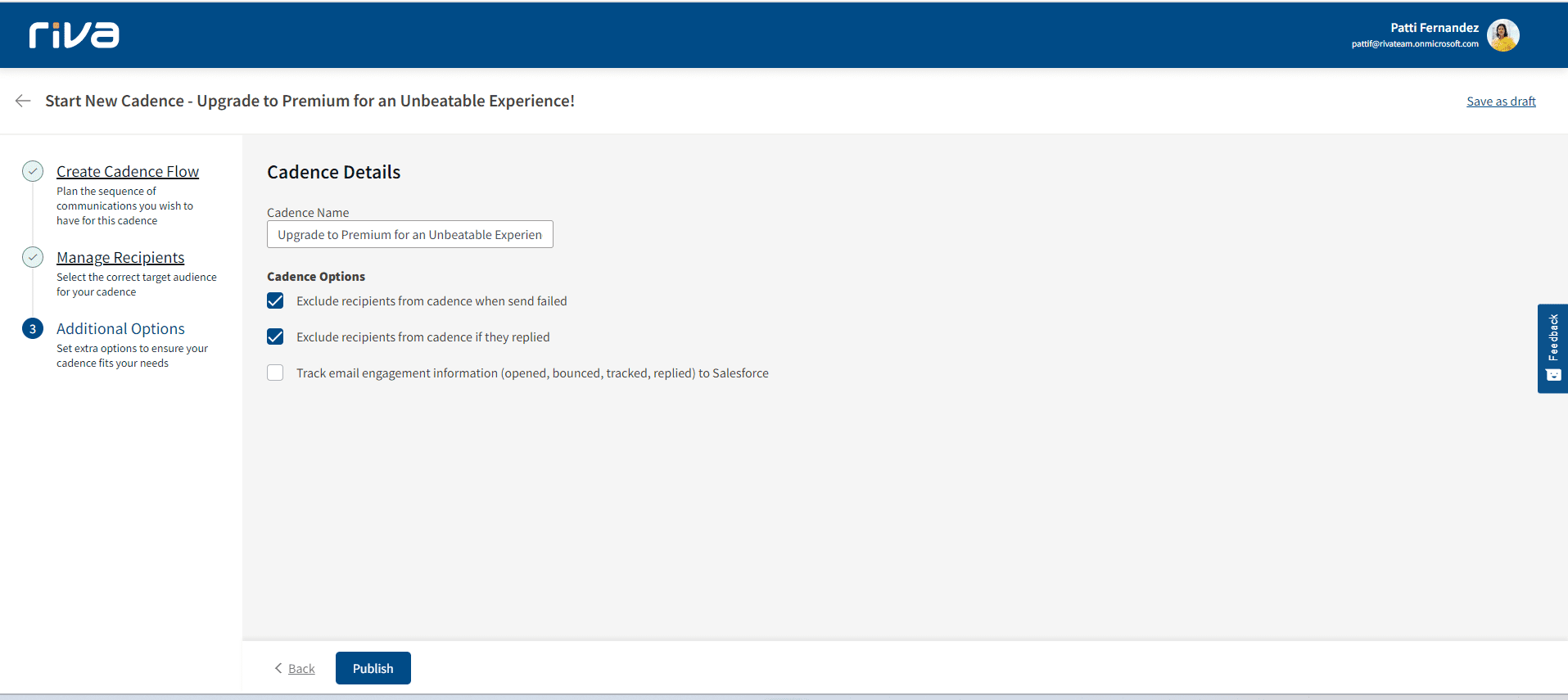
Step 4: Start a New Cadence/Cadence Details
After entering cadence email recipient information, advisors and sellers can select the following options to customize the cadence further:
- Exclude recipients based on send status or engagement.
- Track email engagement in Salesforce for insights into open rates, click-throughs, and responses.
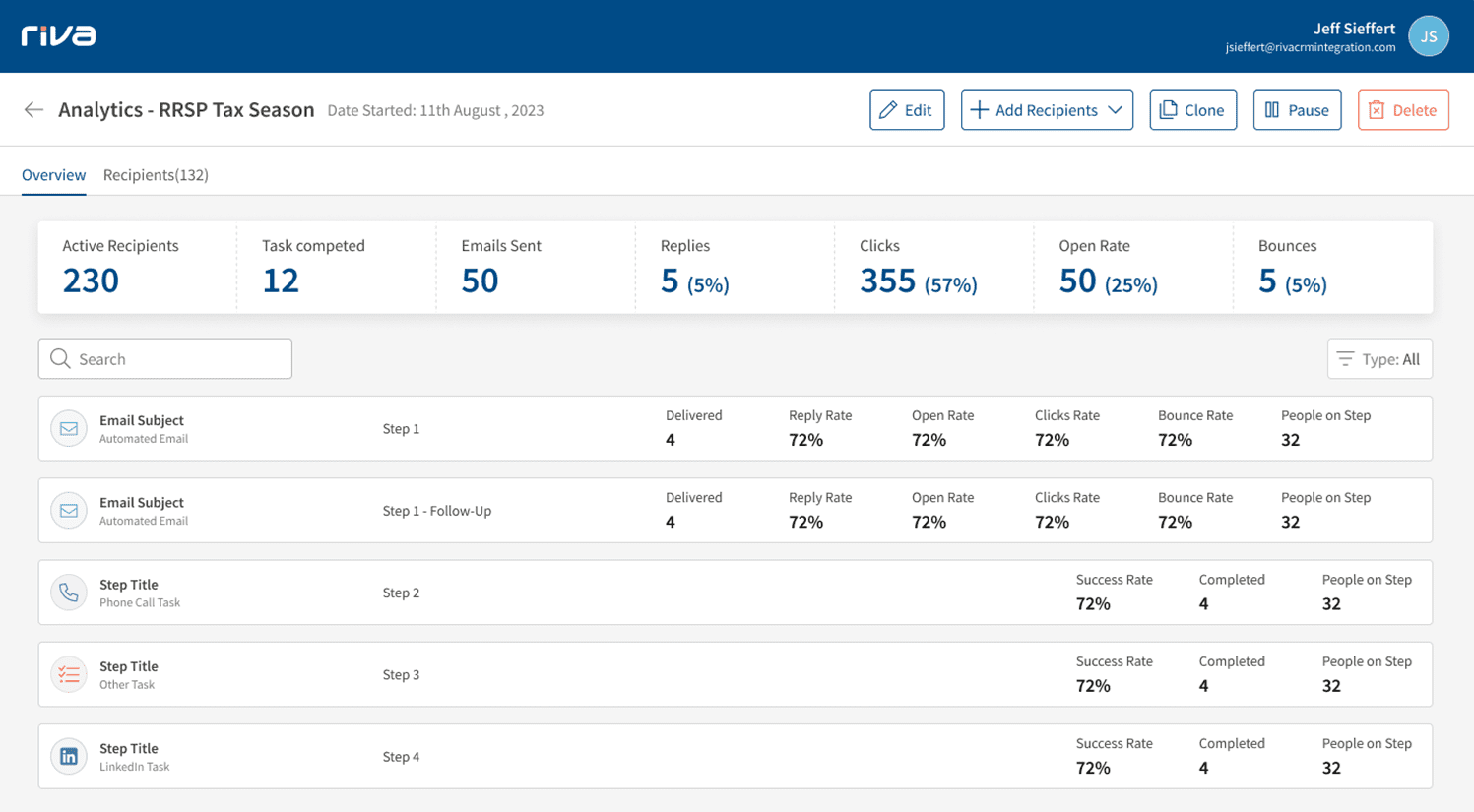
Step 5: Analyze results with Cadence Analytics View
With a clean, intuitive dashboard, Riva Cadences provides detailed reporting on cadence activity. Users can track progress throughout each cadence and utilize that data to fine-tune future efforts.
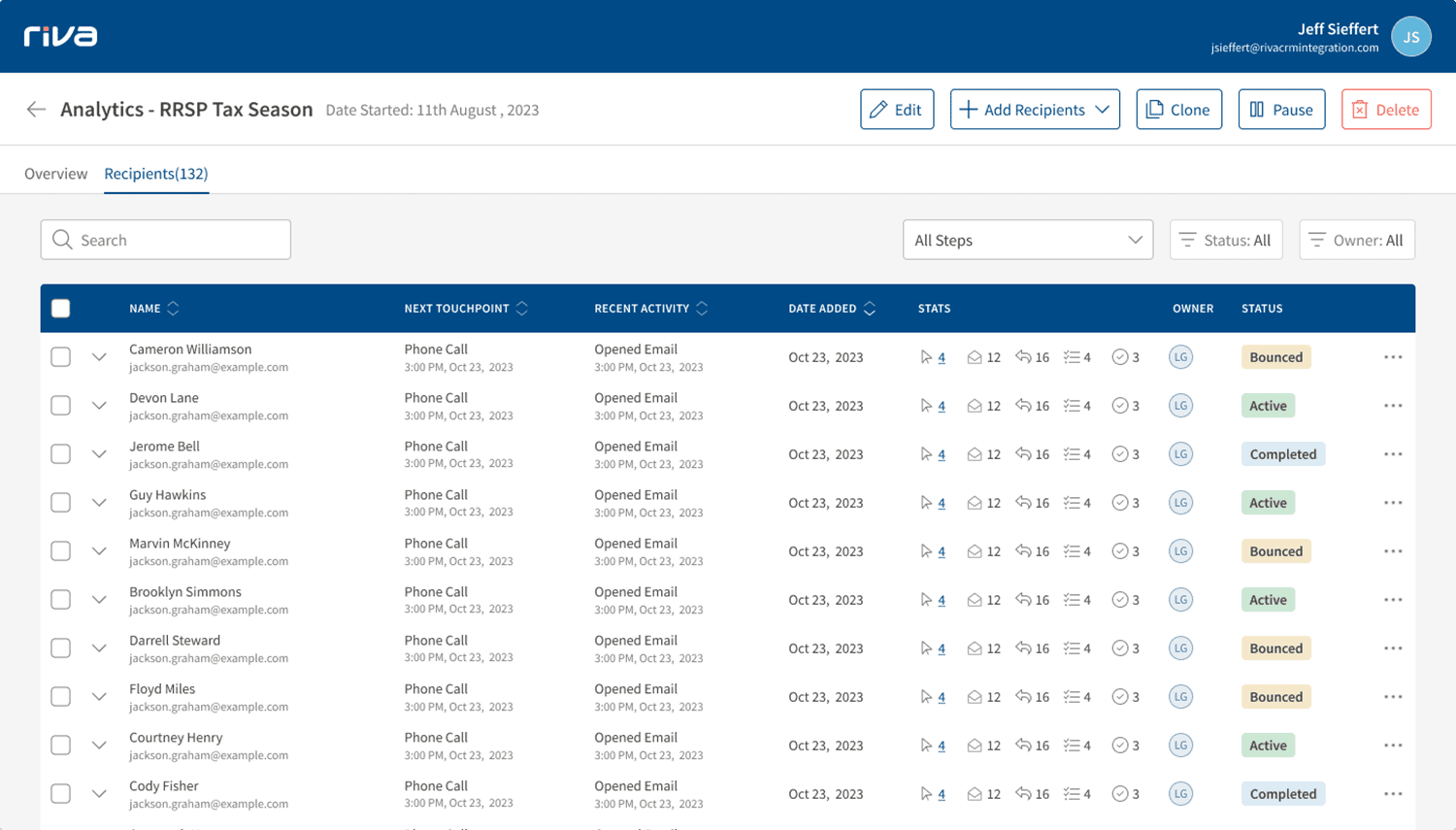
Step 6: Review recipient engagement with Cadence Recipients View
Cadences “Recipients” view allows sellers to review recipient-by-recipient engagement to determine who has interacted with email touchpoints — and how.
Conclusion
We hope that you will find our guide on how to build a sales cadence useful. When thoughtfully designed and effectively executed, sales cadences are among the most powerful sales engagement tools advisors and sellers have at their disposal.
And while building an effective sales cadence isn’t rocket science, it involves a range of skills — and the discipline to use them well. From defining the ideal customer profile and nailing objectives to identifying touchpoints and creating compelling content, it’s a challenging process that’s worth your time and dedication.
By leveraging tools like those included in Riva’s Sales Engagement solution, you’ll have the support you need to connect and engage with customers, meet their needs, close transactions, and build customer lifetime value.
Contact our team to schedule a demo.