

New Forrester Findings on Riva’s ROI

The Real Value Goes Beyond Time Savings
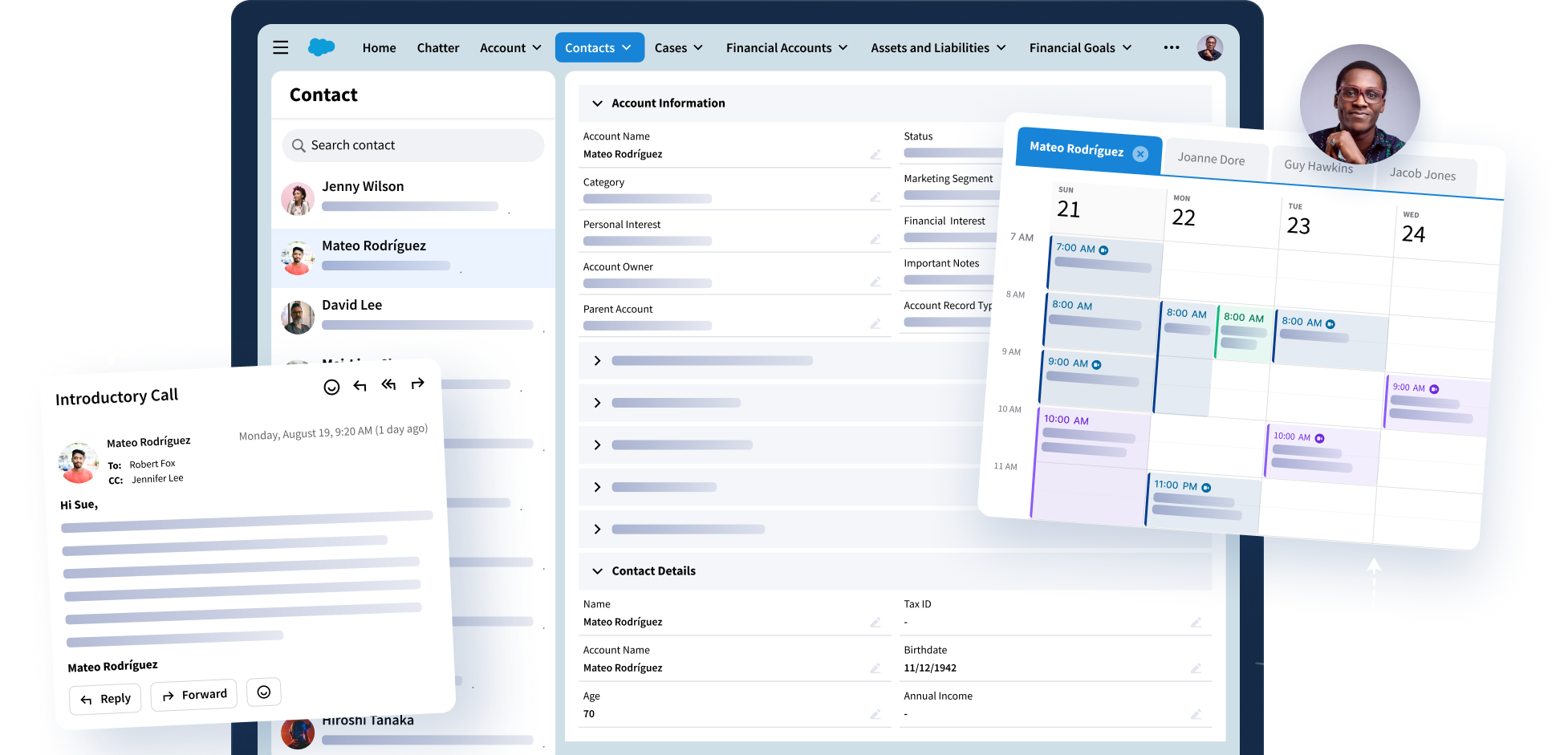
When organizations invest in CRM, they’re not just investing in software. They’re investing in visibility, stronger customer relationships, better forecasting, and increasingly, the trusted data needed to power AI and automation. Yet for many teams, that vision is held back by a familiar challenge: critical information remains scattered across email, calendars, and CRM systems, forcing employees to spend valuable time manually updating records instead of building customer relationships.
For years, businesses have accepted this as the cost of doing business. Sales teams manually log activities, IT teams troubleshoot disconnected systems, and leaders make decisions based on data they know isn’t always complete. The result is more than lost productivity, it impacts customer experience, operational efficiency, and confidence in the data that drives the business.
That’s why Riva commissioned Forrester Consulting to conduct a Total Economic Impact™ (TEI) study. Rather than simply evaluating the technology itself, the study explored what happens when organizations eliminate manual CRM work and create a trusted, automated flow of customer interaction data between email, calendars, and CRM.
The findings reveal a story that’s much bigger than automation.

More importantly, they built a stronger foundation for customer engagement, enterprise-wide data trust, and future AI initiatives.
Those numbers are compelling, but they only tell part of the story.
Behind every hour saved is an sales representative spending more time with customers instead of entering data. Behind every automated synchronization is a CRM record that can be trusted by sales, marketing, operations, and executive leadership alike. And behind every complete customer profile is a stronger foundation for analytics, journey orchestration, and the next generation of AI-powered business initiatives.
In other words, the study doesn’t just highlight the time savings of automating CRM processes. It demonstrates how trusted revenue data has become a strategic advantage for modern organizations.
Understanding the Forrester Total Economic Impact™ Methodology
The Total Economic Impact™ (TEI) methodology, developed by Forrester Consulting, is designed to help organizations evaluate the potential financial impact of technology investments. Rather than relying on product claims alone, the methodology examines customer experiences to assess the costs, benefits, flexibility, and risks associated with implementing a solution.
For this study, Forrester interviewed five decision-makers from organizations using Riva across the financial services and pharmaceutical industries. Based on those interviews, Forrester created a composite organization, a financial services company with $3.5 billion in annual revenue and 1,000 Riva users, to model the potential financial impact over a three-year period.
Using its established TEI framework, Forrester analyzed the organization’s quantified benefits, implementation and operating costs, and potential risks to calculate the overall return on investment. The result is a structured framework organizations can use to evaluate the potential business value of implementing Riva within their own environment.
Before Riva: A Familiar Set of Challenges
The Forrester Total Economic Impact™ of Riva study found that organizations weren’t simply spending time on manual CRM updates. Interviewees described broader operational challenges caused by disconnected email, calendar, and CRM systems, including duplicate meetings, missed appointments, incomplete customer records, poor CRM adoption, misrouted customer emails, and limited visibility across teams.
While each issue may seem relatively small on its own, interviewees explained that together they created significant manual effort. Employees spent time correcting synchronization errors, reconciling duplicate information, and updating CRM records that could have been synchronized automatically.
According to the study, these inefficiencies affected more than productivity.
Organizations were dealing with:
- Duplicate meetings
- Missed appointments
- Incomplete customer records
- Poor CRM adoption
- Misrouted customer emails
- Disconnected customer journeys
By automating synchronization between email, calendar, and CRM systems, organizations reduced manual administrative work while improving the completeness and accuracy of customer data. Interviewees also reported stronger CRM adoption, improved cross-team alignment, and greater trust in customer data for forecasting, analytics, and future AI initiatives.
The Bigger Story: Trusted Data Powers Everything Else
While the ROI numbers are compelling, the customer interviews revealed an even broader business impact.
Interviewees consistently described greater trust in their CRM data after implementing Riva. With customer information automatically synchronized across email, calendar, and CRM systems, organizations reported having more complete and accurate records that could be used with greater confidence across the business.
“Riva helps reduce manual entry and increases sales. It syncs our CRM, calendars, and emails to give us one central source of truth.”
— Senior Director of Infrastructure and Operations, Pharmaceuticals
According to the study, teams used their improved customer data to support forecasting, analytics, customer journey orchestration, and broader decision-making across marketing, operations, finance, and executive leadership. Interviewees also reported stronger CRM adoption and greater readiness for future AI initiatives built on trusted customer data.
The study also found that improved data trust encouraged broader use of CRM data across the enterprise. As organizations gained confidence in the completeness and accuracy of their customer information, they were better positioned to support future digital transformation initiatives and explore new opportunities for automation and AI.
What the ROI Doesn’t Fully Capture
The report also highlights benefits that were not quantified in the financial model but still created meaningful value for the organizations interviewed:
- Sales representatives and advisors spent less time on administrative CRM work and more time building relationships and working on revenue-generating activities.
- Shared customer context helped teams work from a more complete view of activity, reducing duplication and improving collaboration across sales, business development, and other functions.
- More complete communication records helped teams respond to customer needs faster and with greater accuracy.
- More complete CRM records gave organizations greater confidence to use customer data across marketing, operations, finance, analytics, journey orchestration, and future AI initiatives.
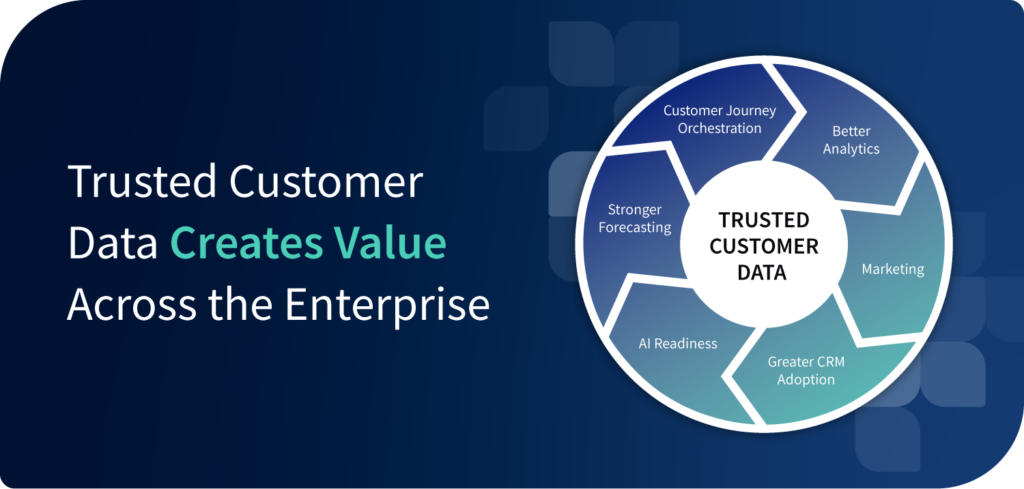
When customer information is accurate and complete, every downstream system performs better.
Preparing for an AI-Driven Future
Artificial intelligence depends on trusted information.
Organizations interviewed by Forrester are already using cleaner CRM data to support:
- Customer summaries
- Journey orchestration
- Analytics
- Future ERP automation
- AI initiatives
AI doesn’t eliminate bad data. It amplifies it. Trusted customer data is becoming one of the most valuable assets organizations can build. As teams strengthen that foundation, they are also better positioned to take advantage of Riva’s broader AI capabilities, including Riva Meeting Intelligence.
By capturing meeting insights and turning them into actionable CRM intelligence, Riva helps organizations standardize AI-generated meeting summaries, notes, decisions, and next steps, then automatically connect them to the appropriate CRM records. Teams can bring together intelligence from meetings, emails, CRM data, and customer conversations to gain richer customer context, prepare faster, strengthen follow-through, and build more complete customer records that support stronger relationships and more informed decision making.
Learn more about Riva Meeting Intelligence
What the Report Shows
The Total Economic Impact™ of Riva shows that trusted revenue data can drive measurable business value while strengthening the way teams work across the enterprise. The quantified benefits are significant: 374% ROI, $1.7 million NPV, and 95,000 hours saved over three years.
But the broader story is just as important. By reducing manual CRM work and improving data completeness, organizations can create a stronger foundation for customer experience, cross-team alignment, analytics, and AI-driven growth.
Download the Full Study
The Total Economic Impact™ of Riva provides a detailed look at the financial and operational benefits organizations achieved after modernizing customer data operations.
Download the Forrester report to explore its full findings.