

AI meeting summaries are useful. But for financial services and life sciences teams, usefulness is only one part of any decision.
These organizations operate in environments where sensitive conversations, documentation expectations, privacy obligations, and internal policies shape how new technology is reviewed. Meeting intelligence can help reduce manual notetaking, capture follow-up items, and preserve relationship context. The larger question is whether meeting data is captured, governed, reviewed, and connected to business systems in a way the organization can trust.
That is where many AI meeting tools get stuck.
Why Do Regulated Enterprises Approach AI Meeting Summaries Differently?
A meeting summary may look polished. It may capture decisions, next steps, objections, risks, and commitments. But if the meeting was captured outside approved channels, stored in a separate note repository, governed by unclear retention rules, or disconnected from the customer relationship management (CRM) system, it can create a new operational burden.
Regulated teams do not need more scattered AI notes. They need governed AI meeting workflows that balance productivity, trust, compliance, and adoption.
Why AI Meeting Summaries Raise Compliance Concerns
Many organizations start by evaluating the quality of AI meeting summaries. Do they capture the right points? Are the action items accurate? Can the summary save time for sellers, advisors, field teams, or account managers?
Those questions matter. But regulated enterprises also need to ask a broader set of questions.
How was the meeting captured? Was the recording or transcript created through an approved system? Who can access the output? How long is it retained? Can it be reviewed or audited when needed? Does it connect back to CRM, or does it sit in another meeting transcription software repository?
Further Reading: 5 Ways to Make AI Meeting Transcripts More Actionable in Your CRM
This is why terms like compliant AI meeting notes can be misleading without context. Compliance depends on an organization’s obligations, policies, configuration, workflows, and controls. A tool can support stronger governance, but it should not be treated as a shortcut around legal, regulatory, privacy, or security review.
A truly secure means of creating AI meeting intelligence needs to fit the way regulated teams already manage sensitive meeting data.
Where Governance Gaps Show Up in Meeting Intelligence
The governance gap is the space between a useful AI-generated meeting summary and an enterprise-ready meeting record that the organization can manage according to policy.
In practice, you can find that gap by answering these five questions:
- Was the meeting captured through an approved source?
- Where are the transcript, recording, summary, and extracted meeting insights stored?
- How long are those outputs retained?
- Who can access, edit, export, or review them?
- Do the outputs connect back to CRM, or do they sit in a separate AI notes silo?
For regulated teams, these are not edge cases. They are the adoption questions that determine whether meeting intelligence can move from individual productivity tool to enterprise workflow.
A standalone AI meeting assistant may help one person remember a conversation. Governed meeting intelligence helps the organization decide how meeting data should be captured, retained, reviewed, protected, and used.
How Approved Capture Supports Trust and Adoption
Meeting intelligence starts with capture: how meeting content is recorded, how participants are informed, how data enters the workflow, and which systems are allowed to process it.
For regulated teams, the capture model matters. Meeting data should come from sources the organization has reviewed and authorized, such as approved recordings or admin-managed meeting platforms. Teams also need clear policies for what can be captured, who can capture it, how participants are informed, where the data goes, and how long it is retained.
Related Reading: The Enterprise Challenge of Meeting Intelligence: Capture, Governance, and Trust
Bot-free meeting recordings can help reduce disruption by avoiding another visible attendee in the meeting. But botless capture is only one part of the larger governance picture. Regulated teams still need approved capture sources, clear participant notice, documented consent practices where applicable, defined access controls, and policies for how meeting data can be used.
This matters for adoption as much as compliance. If participants are unclear about recording or unsure where meeting content will go, trust can break down before the AI summary is ever created. When capture is approved, disclosed, and aligned to policy, meeting intelligence becomes easier to govern and easier for teams to adopt.
Financial Services: Recordkeeping, Review, and CRM Completeness
In financial services, meeting intelligence must fit into a broader recordkeeping and supervisory context.
Broker-dealers and other regulated firms may need to consider rules and firm-specific policies around books and records, preservation, prompt production, supervision, and auditability. SEC guidance states that paragraphs (f) and (j) of Rule 17a-4 under the Securities Exchange Act of 1934 set out electronic recordkeeping and prompt production requirements for broker-dealers that elect to preserve records electronically.
FINRA Rule 4511 requires members to make and preserve books and records as required under FINRA rules, the Exchange Act, and applicable Exchange Act rules, and states that required FINRA books and records must be preserved in a format and media that complies with SEA Rule 17a-4.
That does not mean every AI meeting summary is automatically a regulatory record. It does mean financial services teams should be careful about how meeting intelligence tools create, store, modify, and route meeting outputs.
For a CRM owner, Salesforce admin, business systems analyst, or IT leader, the practical questions are clear. Can we:
- Show where the meeting output came from?
- Control who can access it?
- Preserve the right information for the right period?
- Support review workflows when needed?
- Connect decisions and commitments to the right account, contact, opportunity, or activity?
The more meeting insights live outside approved systems, the harder these questions become.
Assess Your Meeting Intelligence Readiness for Financial Services
Can your advisors, bankers, and relationship managers turn client meetings into governed, CRM-ready intelligence?
Download From Meeting Notes to Meeting Intelligence: A Guide to AI for Financial Services to help your AI, CRM, compliance, supervision, security, and business teams evaluate how client meeting context is captured, reviewed, retained, and connected to CRM, relationship history, and follow-up workflows.
Life Sciences: Sensitive Engagements, Documentation, and Approved Infrastructure
Life Sciences organizations face a different set of workflows, but the same core issue: sensitive conversations need clear controls.
Commercial teams, medical engagement teams, field teams, and account teams may all depend on meeting context. Some meetings may involve health care professionals, formulary discussions, patient support topics, medical information requests, or other sensitive business context.
Not every Life Sciences meeting involves protected health information, and HIPAA should not be used as a blanket label for every conversation. But when electronic protected health information is involved, the HIPAA Security Rule requires appropriate administrative, physical, and technical safeguards to protect its confidentiality, integrity, and availability.
That framing matters. A safer review question is, “Can this workflow support our privacy, security, access, documentation, and retention requirements when sensitive information may be involved?”
FDA-style data integrity expectations can also be useful as an analogy for regulated digital workflows. 21 CFR Part 11 applies to electronic records that are created, modified, maintained, archived, retrieved, or transmitted under FDA records requirements. For closed systems, Part 11 also references controls such as record protection, access limits, and secure, computer-generated, time-stamped audit trails for actions that create, modify, or delete electronic records.
Of course, that does not make Part 11 a blanket requirement for every life sciences meeting. It does, however, show why audit trails, controlled access, record integrity, and retrievability are familiar expectations in regulated environments.
A Checklist of What Governed AI Meeting Workflows Need
A governed AI meeting workflow should give IT, CRM, operations, security, and compliance teams a shared way to evaluate meeting intelligence.
Here is a practical checklist.
1. Approved Capture
Meeting intelligence should start with approved sources, not unmanaged recording paths or personal note workflows. Regulated teams need to know how meeting content enters the system, which platforms are supported, what consent workflows apply, and who can enable capture.
For many organizations, this means reviewing how the workflow handles Teams meeting transcription, Zoom meeting transcription, recordings, transcripts, summaries, and extracted fields.
2. Clear Retention
Meeting outputs should not live forever by default, disappear without policy, or remain in personal folders. Teams need clarity on how recordings, transcripts, summaries, and extracted meeting insights are retained, deleted, or archived.
3. Auditability
Auditability means the organization can understand what happened to meeting data over time. That may include access, changes, exports, review actions, and system activity where applicable.
For regulated teams, auditability supports trust, review, and accountability.
4. Access Control
Meeting intelligence may include sensitive customer, patient, commercial, or strategic context. Access should follow role, policy, and business need. Admins should be able to manage who can view, use, share, and act on meeting outputs.
5. CRM Connection
Meeting intelligence becomes more valuable when it connects to the system of record.
A summary that stays in a personal note app may help one employee. A summary that connects to CRM can help the account team, service team, manager, or next relationship owner understand what happened and what needs to happen next.
For regulated industries, CRM connection also supports completeness. Decisions, commitments, objections, risks, and next steps should not be trapped in disconnected enterprise AI meeting notes. They should become part of governed customer context.
Find What’s Blocking Your Meeting Intelligence Workflow
Where is your meeting intelligence workflow losing value, creating risk, or adding manual effort?
Use Riva’s quick online assessment to identify the gaps that may be limiting meeting capture, governance, output quality, CRM visibility, AI control, and relationship continuity.
Based on your results, you’ll see where your biggest risks and opportunities are, with guidance to help you improve meeting capture, strengthen governance, support human review, and connect trusted meeting intelligence to CRM.
Why CRM Connection Turns Meeting Insights Into Business Value
Enterprise AI governance is sometimes treated as a brake on innovation. For meeting intelligence, governance is what makes adoption possible.
When AI meeting summaries are governed from capture through CRM connection, regulated teams can move faster with more confidence. They can reduce manual note-taking without losing control of sensitive information. They can improve follow-up without scattering meeting outputs across personal tools. They can help teams see relationship context without creating another unmanaged data store.
That matters for every buyer lens involved.
For CRM owners and Salesforce admins, meeting intelligence can support CRM completeness instead of creating another cleanup burden.
For IT and operations leaders, AI meeting compliance becomes easier to evaluate when workflows fit approved systems, admin controls, and business processes.
For security and compliance leaders, meeting data can be assessed through known controls: capture, access, retention, auditability, and review.
For line-of-business leaders, teams can spend less time reconstructing what happened and more time acting on what matters.
Recommended Reading: The Hidden Cost of Reconstructing Customer Context Before Every Meeting
Where Riva Meeting Intelligence Fits
Many meeting AI tools create another disconnected note layer. Riva Meeting Intelligence is designed for organizations that need meeting AI to fit governed enterprise workflows.
Riva supports approved meeting capture, avoids bot-led disruption, generates structured meeting outputs, and connects meeting context to CRM workflows and relationship records.
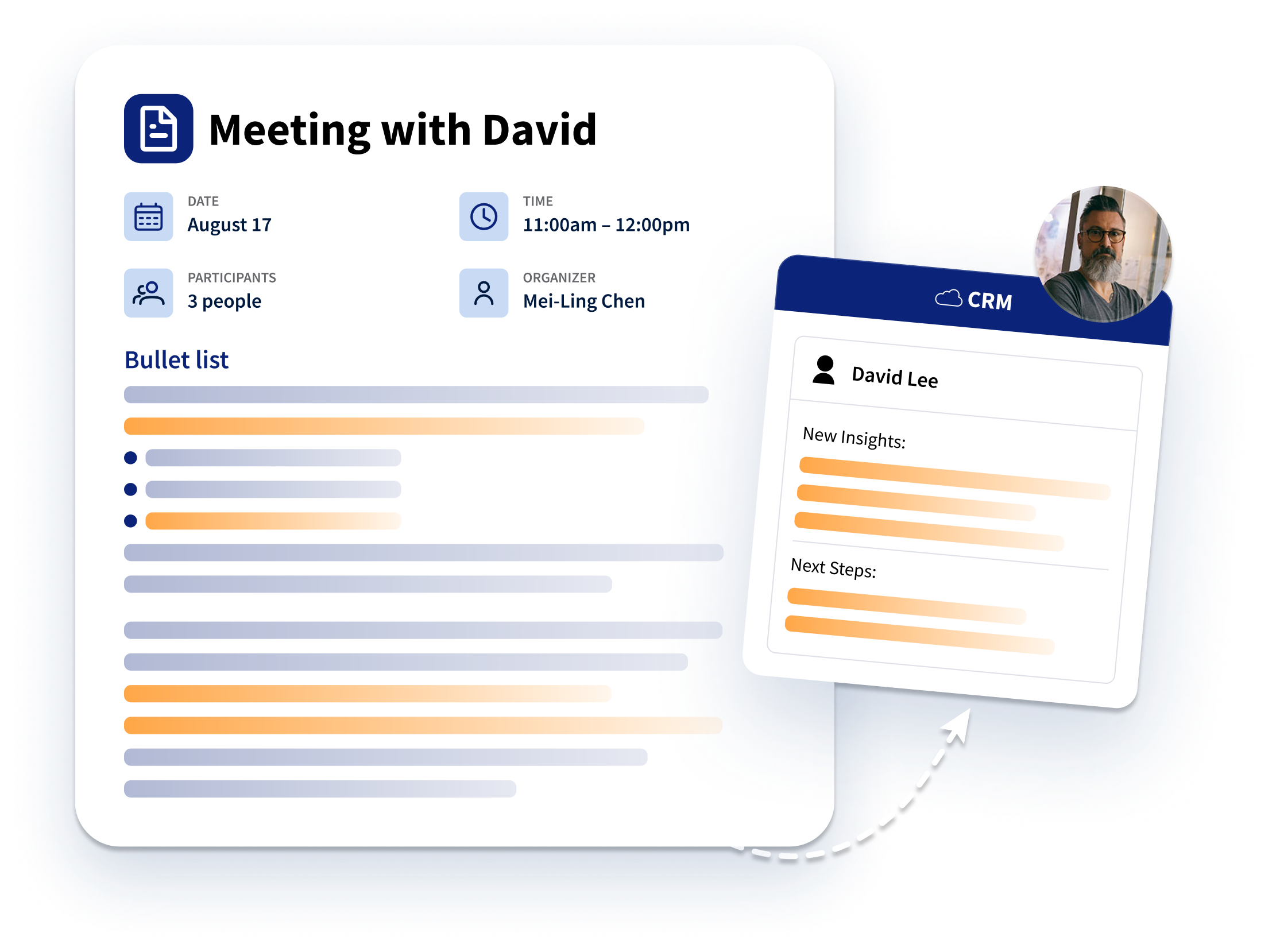
The key idea is simple: meeting intelligence should not stop at notes. For regulated teams, it should turn client conversations into structured, usable, CRM-ready intelligence while respecting the controls they already need.
To assess your current workflow, download From Meeting Notes to Meeting Intelligence: A Regulated Enterprise Guide to AI for Client Meetings and use the readiness checklist to identify gaps across capture, consent, governance, CRM readiness, and adoption.
Questions? We have Answers
What are AI meeting summaries?
What are AI meeting summaries?
AI meeting summaries are AI-generated recaps of meeting content. They can help capture key discussion points, decisions, objections, risks, next steps, and follow-up items so teams do not have to rely only on memory or manual notes.
For regulated enterprises, the summary itself is only one part of the workflow. Teams also need to understand how the meeting was captured, where the transcript and summary are stored, who can access them, how long they are retained, and whether the output connects back to the customer relationship management (CRM) system.l
Why do regulated enterprises approach AI meeting summaries differently?
Why do regulated enterprises approach AI meeting summaries differently?
Regulated enterprises often handle sensitive client, customer, patient, commercial, or financial information. That means AI meeting summary tools are usually reviewed through more than a productivity lens.
Financial services, life sciences, and other regulated teams may need to evaluate capture methods, consent practices, privacy obligations, access controls, retention rules, auditability, CRM connectivity, and internal policies before adopting meeting AI. A summary may be useful, but if it is created outside approved workflows or stored in a disconnected notes repository, it can create new governance and operational risks.
How do AI meeting bots affect user adoption?
How do AI meeting bots affect user adoption?
Many AI meeting tools use bots that join meetings as visible participants. In some environments, this can work well. In regulated or relationship-driven settings, it can also create friction.
Participants may wonder who or what has joined the meeting, whether the tool has been approved, how the meeting is being recorded, where the data will go, and how consent is being handled. Advisors, sellers, field teams, or relationship managers may also be hesitant to introduce an unfamiliar AI participant into sensitive client conversations.
A bot-free approach can reduce disruption, but it does not remove the need for governance. Organizations still need approved capture sources, clear participant notice, documented consent practices where applicable, defined access controls, and policies for how meeting data can be used. ate
What governance controls are important for AI meeting workflows?
What governance controls are important for AI meeting workflows?
Important governance controls for AI meeting workflows include approved capture, clear retention, auditability, access control, and CRM connection.
Approved capture helps ensure meeting content comes from sources the organization has reviewed and authorized. Retention policies define how recordings, transcripts, summaries, and extracted meeting insights are stored, deleted, or archived. Auditability helps teams understand what happened to meeting data over time. Access controls help ensure sensitive meeting outputs are available only to the right people. CRM connection helps meeting intelligence become part of the governed customer record, rather than another disconnected AI notes silo.
Together, these controls help regulated teams evaluate meeting intelligence as an enterprise workflow, not just an individual productivity tool.
How can Riva Meeting Intelligence help use AI meeting summaries in regulated industries, such as financial services and life sciences?
How can Riva Meeting Intelligence help use AI meeting summaries in regulated industries, such as financial services and life sciences?
Riva Meeting Intelligence is designed for organizations that need meeting AI to fit governed enterprise workflows. It supports approved Teams and Zoom meeting workflows, avoids adding a visible AI bot to the live meeting, and uses AI to generate structured summaries, notes, key decisions, next steps, and follow-up actions.
Riva also connects meeting outputs to CRM workflows and relationship records, helping teams turn meeting content into usable client and account context. For financial services and life sciences organizations, that can support more consistent documentation, stronger follow-through, better relationship continuity, and clearer governance across capture, access, retention, and CRM readiness.
Product, legal, security, and compliance teams should still review final workflows against the organization’s own policies, obligations, and configuration requirements. d